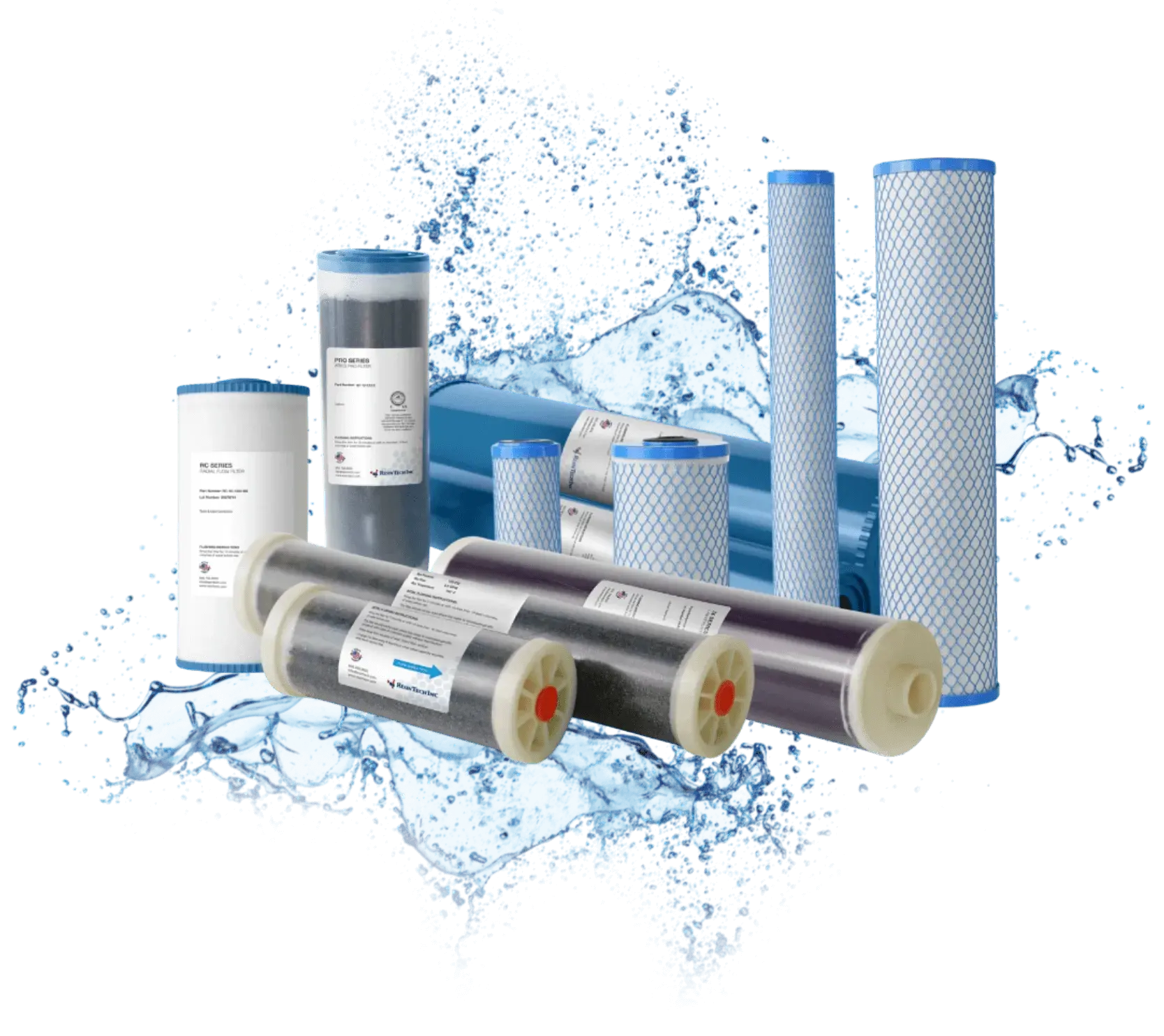
This glossary is intended to smooth the OEM filter design process. It contains helpful definitions of key terms in preparation and support of a collaborative filter design process. This is part of the ResinTech approach with industrial application engineering customers in order to achieve both their functional as well as business objectives.
ABS Acrylonitrile Butadiene Styrene, a common thermoplastic polymer used in filter manufacturing.
Absorption Involves a substance, the absorbate, where the molecules are drawn into the entire volume of the material, the absorbent.
Activated Carbon (AC/GAC/AGC) or Granular Activated Carbon Filter media that adsorbs organic compounds, chlorine, VOCs, pesticides, removing unwanted substances and often used to improve taste and odor. Works through physical adsorption rather than chemical reaction. This is also used as a pre-treatment, critical for removing chlorine that can damage or use up downstream ion exchange resins which are otherwise intended to more selectivity target other filtration.
Adsorption The process where molecules of a gas, liquid, or dissolved substances, the adsorbate, adhere to the surface of a solid or liquid, or the adsorbent.
Bed Volume The total volume of media inside a filter cartridge. Directly correlates with contaminant loading capacity and service life. It’s the amount of material by which a target material engages. Filters are designed with a balance of not too little bed volume that requires too frequent changes, but not too much that is unnecessarily wasteful. Filter performance is often a factor of Bed Volume and Contact Time.
Bed Volumes per Hour (BV/h) Flow rate measurement indicating how many times the entire filter volume is processed per hour. Ion exchange resins typically operate at 10-40 BV/h depending on application requirements.
Breakthrough Time The point when contaminants start passing through the filter media without being captured. This signals the end of the filter’s effective life. This is a factor in engineering the filter for intended performance, since proper sizing prevents breakthrough during expected service intervals.
Capacity Total amount of life of the filter to remove the targeted contaminant, based on media volume, flow rate, pressure. Can be measured in gallons, liters, grains, etc.
Channeling When water finds the easiest path through filtering media, bypassing most of the treatment material. Reduces effectiveness and shortens filter life. Prevented through proper flow distribution design.
Conditioning Treating water to alter, remove, or add mineral, chemical, or bacterial content within a water processing or distribution system. It's a broad term encompassing various methods like water softening and water purification, all aimed at improving water quality for specific uses. Essentially, it makes water more suitable for drinking, industrial applications, or other purposes by removing undesirable components or reducing their concentration. It is often the preceding step before polishing, or purifying water to an ultrapure water, or Type 1 grade.
Conductivity Water conductivity is the ability of water to conduct an electrical current, primarily influenced by the concentration of dissolved ions (charged particles) in the water. Higher concentrations of dissolved salts or minerals lead to increased conductivity, as these ions enable the movement of electrons. The unit of measurement for conductivity is typically siemens per centimeter (S/cm) or mhos per centimeter (mho/cm). MΩ. (metrology) Symbol for megaohm, an SI unit of electrical resistance equal to 106 ohms; μS: This is the standard notation, using the Greek letter mu (µ) to denote "micro" (10^-6) and S for Siemens. See also Resistivity.
Contact Time Duration water spends in contact with filter media. Insufficient contact time means incomplete contaminant removal - like trying to dissolve sugar without stirring. Different media types require different minimum contact times.
Contaminants of Concern Substances identified as posing a potential or unacceptable risk to human health or the environment. These can be PFAS, Uranium, Nitrates, Arsenic and more.
Contaminant Loading Capacity The total amount of contaminants a filter can remove before requiring replacement. Depends on media type, bed volume, and water quality. Critical for predicting service life and replacement schedules.
Empty Bed Contact Time (EBCT) Theoretical time water spends in contact with filter media, calculated as bed volume divided by flow rate. Carbon filters typically need 5-20 minutes EBCT, while ion exchange may need 30 seconds to several minutes.
Flow Distribution How evenly water moves through the filter media. Poor distribution causes channeling and reduces efficiency. Internal baffles or foam pads help ensure uniform flow and maximize media utilization.
Flow Rate Volume of water processed per unit time. Creates a balance between system performance and treatment effectiveness. Too fast reduces contact time, too slow creates system bottlenecks.
Fouling Accumulation of particles or contaminants that block filter media or reduce effectiveness. Pre-filtration prevents fouling of expensive primary media. Common in applications with high particulate loads.
Grains/Grain Capacity In water softening, "grain capacity" refers to the amount of hardness minerals a water softener can remove before needing to regenerate. 1 grain per gallon (GPG) is equal to 17.1 PPM or 17.1 mg/L.
HDPE High Density Polyethylene, a thermoplastic polymer used for filter manufacturing.
Ion Exchange Resin (IX Resin) Specialized beads that remove dissolved ions from water through chemical exchange. Cation resins remove positive ions (calcium, magnesium, heavy metals), and anion resins remove negative ions (nitrates, chlorides).
Mixed Bed A term used to describe when two medias (primarily IX medias) are mixed together at a set ratio – typically used for high purity DI applications
Media The active filtration material inside the filter housing. Common types include ion exchange resin, activated carbon, and specialty media like KDF. Media selection depends on target contaminants and application requirements.
NPT (National Pipe Thread) Standard tapered threaded connection system for filter attachments. Common sizes include ¼", ⅜", and ½" NPT. Must match system plumbing for proper installation and leak-free operation.
NSF/ANSI Standards Certification standards for water treatment equipment. NSF 42 covers taste and odor, NSF 53 covers health effects, NSF 61 covers material safety. Required for many drinking water applications.
PET Polyethylene Terephthalate, a type of polyester used for filter screen manufacturing.
PFAS Polyfluoroalkyl substances, are a group of man-made chemicals that contain a unique carbon-fluorine bond, making them highly resistant to heat, water, and oil. This makes them useful in a wide range of applications, but also means they persist in the environment and can accumulate in living organisms. They do not readily break down in the environment and are known to pose health threats. –The most commonly found PFAS species are PFOA and PFOS.
Polishing A final stage of purification that removes fine particulate matter, dissolved impurities, and residual contaminants from water that has already undergone some level of treatment. It aims to achieve a high level of clarity and purity, often producing "ultrapure" water for specific applications.
Pressure Drop Reduction in water pressure as it passes through the filter. Excessive pressure drops forces pumps to work harder and reduces system efficiency. Should typically stay below 5 psi for optimal performance.
PP Polypropylene, a strong, versatile thermoplastic polymer used in filter manufacturing.
PPB Parts per billion
PPM Parts per Million
PPT Parts per Trillion
Pre-filtration Initial filtration stage that removes larger particles or specific contaminants before primary treatment. Protects expensive downstream media from fouling and extends service life.
Quick Connect Standard tubing connection used with ¼” and 3/8” OD tubing to allow a quick install/uninstall from filters and other fittings
Regeneration Media regeneration process either through additional rinsing or processing, addition of restore liquid, can include flushing out.
Resistivity Water resistivity is a measure of how well water resists the flow of electrical current. It's the inverse of conductivity, meaning that water with high resistivity has low conductivity, and vice versa. Higher resistivity in water generally indicates a lower concentration of dissolved ions or impurities, as these ions carry electrical current. See also Conductivity.
RO (Reverse Osmosis) A process by which a solvent passes through a porous membrane in the direction opposite to that for natural osmosis when subjected to a hydrostatic pressure greater than the osmotic pressure.
Split Bed A term used to describe when a mixed bed “splits” during filter operation and the two medias separate back into distinct beds. Often a result of improper media fill/packing or irregular flow conditions.
Softening The process of reducing the concentration of certain minerals, primarily calcium and magnesium, in water, which are responsible for its hardness. This process typically involves removing these minerals using a water softener, often an ion exchange unit, which replaces them with sodium or potassium ions.
Service Life Expected operating duration before filter replacement is needed. It depends on water quality, flow rate, and contaminant loading. Proper sizing balances service life with system performance requirements.
Spin-Welding Manufacturing technique where two plastic components are fused together using rotational heat and pressure. Typically used to weld endcaps onto filter tubes. Creates leak-proof seals that withstand system pressures while maintaining structural integrity.
Thermal Cycling Repeated heating and cooling that filters experience in temperature-variable applications. Important consideration for cooling systems, medical lasers, and industrial processes where temperature fluctuations occur.
Ultrasonic Welding Manufacturing technique where two components, typically thermoplastics, are fused together using high-frequency ultrasonic acoustic vibrations to create a localized solid-state weld. Typically used to weld end caps onto filter tube or screens onto filter end caps. Creates leak-proof seals that withstand system pressures while maintaining structural integrity.
UV Ultraviolet water treatment is a disinfection method that uses UV light to target harmful microorganisms like bacteria and viruses. Typically, 185nm and 254nm wavelengths are used.
Vertical Integration Manufacturing approach where all filter components are produced in a single facility. This eliminates supplier coordination, reduces costs, increases resiliency and improves quality consistency compared to multi-supplier assembly.
Cooling Loop Filtration Water treatment for closed-loop cooling systems. Prevents fouling of heat exchangers and extends equipment life. Requires consideration of thermal cycling and chemical compatibility.
Deionization (DI) Process of removing dissolved ions to produce ultra-pure water. Typically uses mixed bed ion exchange resins. Critical for laboratory equipment and high-purity manufacturing processes.
Humidification Filtration Water treatment for humidification systems. Prevents mineral buildup and biological growth. Often requires softening and disinfection capabilities.
Medical Device Filtration Specialized filtration for medical equipment like lasers. Requires strict quality control, material certifications, and consistent performance. Often includes requirements for USP (United States Pharmacopeia) materials.
Spot-Free Rinsing Final rinse using deionized water to prevent water spots on surfaces. Common in car washes and manufacturing processes. Requires very low dissolved solids content.
Understanding these terms helps engineers make informed decisions about filter specifications. Each term represents a design choice that impacts system performance, cost, and maintenance requirements. The glossary provides the foundation for discussing filtration needs with suppliers and ensuring optimal system design.
This glossary serves as a practical reference for OEM filter design and sourcing decisions. For specific applications, consult with ResinTech filtration engineers and specialists to ensure proper system design and media selection.
Learn more about designing industrial OEM filters for your application.

.png)

.webp)
.webp)
.webp)
.webp)
.webp)

.png)


.png)


.webp)